"Building Type-Safe API Clients with the Procedure Pattern"
,
The procedure pattern provides a type-safe, declarative approach to building API clients in TypeScript applications. This pattern simplifies API calls while ensuring type safety throughout your application.
Core Concepts
-
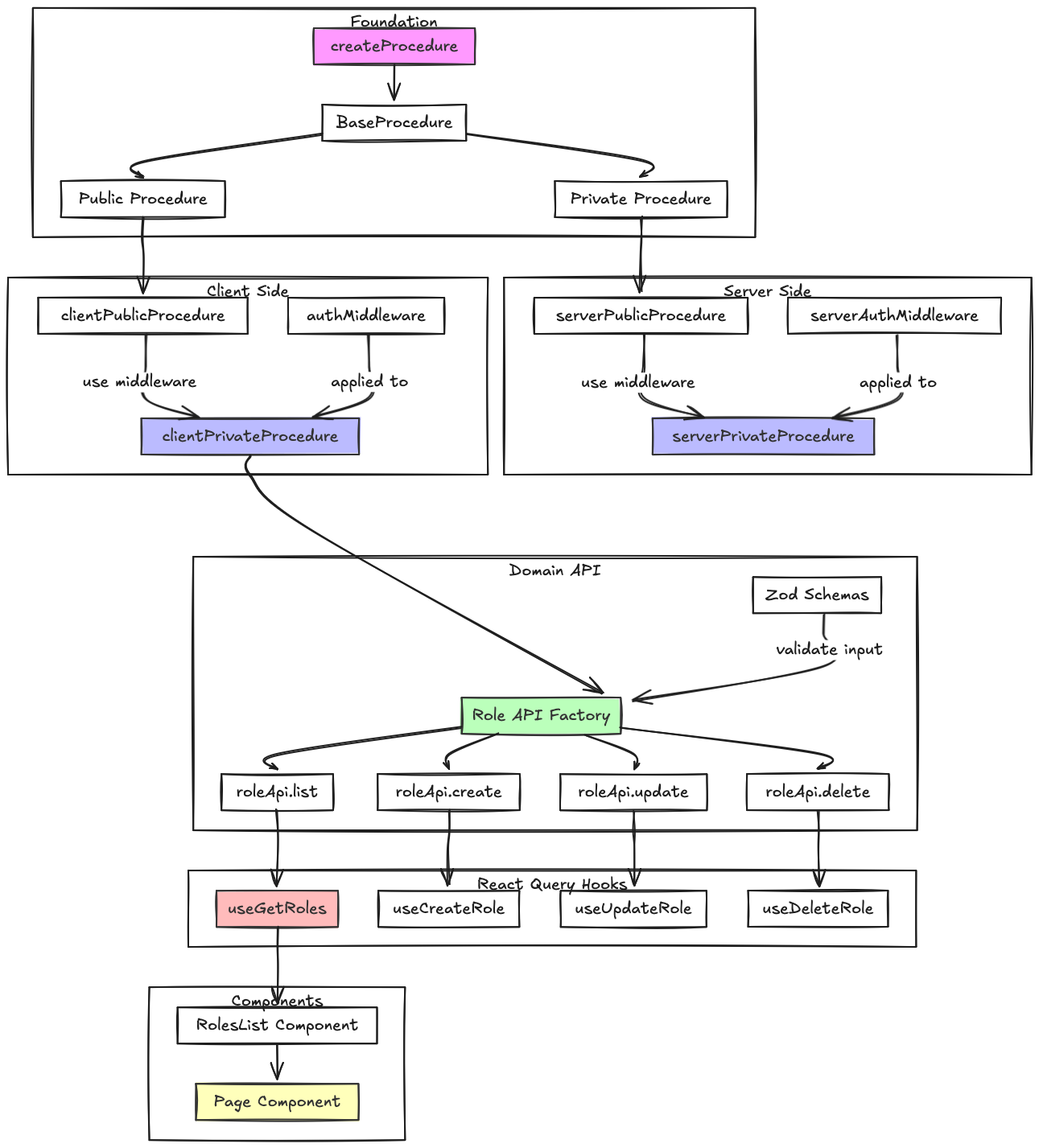
Procedures - Base objects that define the API context and middleware chain
-
Endpoints - Type-safe functions created from procedures for specific API operations
-
Middleware - Functions that modify the request context before execution
Architecture Diagram
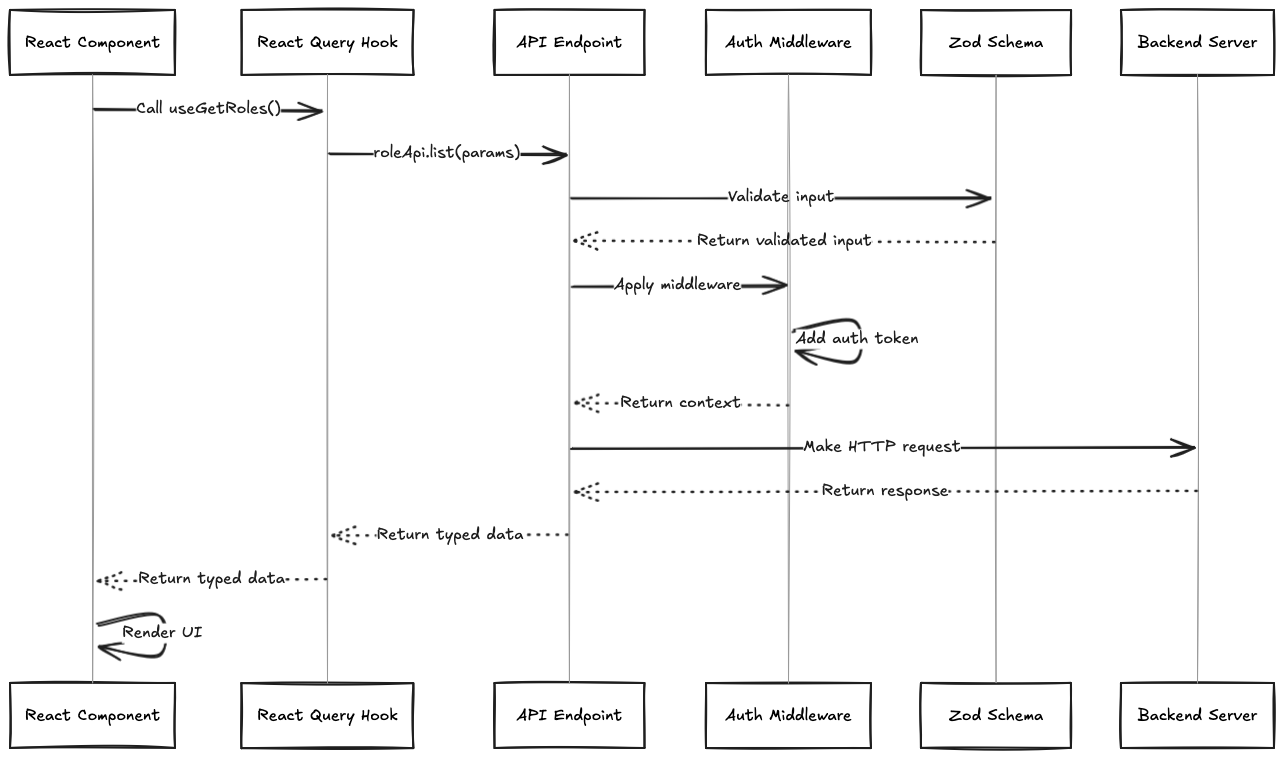
Request Flow Sequence
Implementation
1. Create the Base Procedure Utility
First, create a utility for building procedures:
1// lib/utils/create-procedure.ts
2import { z, type ZodSchema } from 'zod';
3
4// Base context for requests
5export interface BaseContext {
6  headers?: Record<string, string>;
7  formData?: boolean;
8}
9
10// Options for creating a procedure
11export interface ProcedureOptions {
12  apiBase: string;
13}
14
15// Create a procedure with middleware support
16export function createProcedure<TContext extends BaseContext = BaseContext>(
17  options: ProcedureOptions
18): BaseProcedure<TContext> {
19  // Implementation omitted for brevity
20  // See full implementation in github
21}
22
2. Define Client Procedures
Set up both public and authenticated procedures:
1// lib/api/client-procedures.ts
2import { env } from '@/env/client';
3import { getAccessToken } from '../utils/client-cookies';
4import { createProcedure, type BaseContext } from '../utils/create-procedure';
5
6// Public procedure - no authentication
7export const clientPublicProcedure = createProcedure({
8  apiBase: env.NEXT_PUBLIC_API_URL,
9});
10
11// Auth context type
12export interface AuthContext extends BaseContext {
13  headers: {
14    Authorization: string;
15  };
16}
17
18// Auth middleware
19export const authMiddleware = (ctx: BaseContext): AuthContext => {
20  const token = getAccessToken();
21
22  if (!token) {
23    throw new Error('Authentication required');
24  }
25
26  return {
27    ...ctx,
28    headers: {
29      ...ctx.headers,
30      Authorization: `Bearer ${token}`,
31    },
32  };
33};
34
35// Private procedure - requires authentication
36export const clientPrivateProcedure = clientPublicProcedure.use(authMiddleware);
37
3. Define Server Procedures
For server-side API calls:
1// lib/api/server-procedures.ts
2import 'server-only';
3import { env } from '@/env/server';
4import { createProcedure } from '../utils/create-procedure';
5import { serverAuthMiddleware } from './server-auth-middleware';
6
7// Public server procedure
8export const serverPublicProcedure = createProcedure({
9  apiBase: env.API_URL,
10});
11
12// Private server procedure
13export const serverPrivateProcedure = serverPublicProcedure.use(serverAuthMiddleware);
14
4. Define Domain Types
Create type definitions for your domain models:
1// lib/api/roles/role-types.ts
2import type { BaseResponse, PaginatedResponse } from '../types';
3
4export interface Role {
5  id: string;
6  name: string;
7  description: string;
8  is_active: boolean;
9  permissions: RolePermission;
10  created_at: string;
11  updated_at: string;
12}
13
14export interface RolePermission {
15  [key: string]: string;
16}
17
18export type RoleListResponse = BaseResponse<
19  PaginatedResponse & {
20    roles: Role[];
21  }
22>;
23export type RoleResponse = BaseResponse<Role>;
24
5. Implement API Modules
Create domain-specific API modules:
1// lib/api/roles/role-api.ts
2import { z } from 'zod';
3import { clientPrivateProcedure, type AuthContext } from '../client-procedures';
4import { API_ENDPOINTS } from '@/config/api';
5import type { RoleListResponse, RoleResponse } from './role-types';
6import { getByIdSchema } from '../schemas';
7import type { BaseProcedure } from '../../utils/create-procedure';
8
9// Validation Schemas
10const createRoleSchema = z.object({
11  name: z.string().min(1),
12  description: z.string().min(1),
13  permissions: z.array(z.string()),
14  is_active: z.boolean().default(false),
15});
16export type CreateRoleParams = z.infer<typeof createRoleSchema>;
17
18const updateRoleSchema = z.object({
19  id: z.string().min(1),
20  name: z.string().min(1),
21  description: z.string().min(1),
22  permissions: z.array(z.string()),
23  is_active: z.boolean().default(false),
24});
25export type UpdateRoleParams = z.infer<typeof updateRoleSchema>;
26
27export const getRolesParamsSchema = z.object({
28  page: z.number().min(1).default(1),
29  limit: z.number().min(1).default(10),
30  search: z.string().optional(),
31  sortBy: z.string().optional(),
32  sortOrder: z.enum(['asc', 'desc']).default('asc'),
33});
34export type GetRolesParams = z.infer<typeof getRolesParamsSchema>;
35
36// Factory function for creating role API with any procedure
37export function getRoleApi(procedure: BaseProcedure<AuthContext>) {
38  return {
39    list: procedure.input(getRolesParamsSchema).get<RoleListResponse>(API_ENDPOINTS.roles),
40    create: procedure.input(createRoleSchema).post<RoleResponse>(API_ENDPOINTS.roles),
41    update: procedure.input(updateRoleSchema).put<RoleResponse>(`${API_ENDPOINTS.roles}/:id`),
42    delete: procedure.input(getByIdSchema).delete<RoleResponse>(`${API_ENDPOINTS.roles}/:id`),
43    getById: procedure.input(getByIdSchema).get<RoleResponse>(`${API_ENDPOINTS.roles}/:id`),
44  };
45}
46
47// Default client-side API using client private procedure
48export const roleApi = getRoleApi(clientPrivateProcedure);
49
6. Create React Query Hooks
Create React hooks for client-side data fetching:
1// lib/api/roles/role-hooks.ts
2import {
3  useMutation,
4  useQueryClient,
5  useSuspenseQuery,
6  type UseMutationOptions,
7  type UseQueryOptions,
8} from '@tanstack/react-query';
9import { roleApi, type CreateRoleParams, type UpdateRoleParams, type GetRolesParams } from './role-api';
10import type { RoleListResponse, RoleResponse } from './role-types';
11import { isErrorResponse, type ErrorResponse } from '../../utils/create-procedure';
12
13export const useGetRoles = (
14  params?: GetRolesParams,
15  options?: Omit<UseQueryOptions<RoleListResponse, ErrorResponse>, 'queryFn' | 'queryKey'>
16) => {
17  return useSuspenseQuery({
18    queryKey: ['roles', params],
19    queryFn: async () => {
20      const result = await roleApi.list(params);
21      if (isErrorResponse(result)) {
22        throw new Error(result.error);
23      }
24      return result.data;
25    },
26    ...options,
27  });
28};
29
30export const useCreateRole = (
31  options?: Omit<UseMutationOptions<RoleResponse, ErrorResponse, CreateRoleParams>, 'mutationFn'>
32) => {
33  const queryClient = useQueryClient();
34
35  return useMutation({
36    mutationFn: async (input: CreateRoleParams) => {
37      const result = await roleApi.create(input);
38      if (isErrorResponse(result)) {
39        throw new Error(result.error);
40      }
41      queryClient.invalidateQueries({ queryKey: ['roles'] });
42      return result.data;
43    },
44    ...options,
45  });
46};
47
48// Additional hooks for update, delete, etc.
49
7. Usage in Components
1// app/(dashboard)/users/roles/page.tsx
2import { Suspense } from 'react';
3import { useGetRoles } from '@/lib/api/roles/role-hooks';
4
5function RolesList() {
6  const { data } = useGetRoles();
7
8  return (
9    <div>
10      <h1>Roles</h1>
11      <ul>
12        {data.roles.map((role) => (
13          <li key={role.id}>{role.name}</li>
14        ))}
15      </ul>
16    </div>
17  );
18}
19
20export default function RolesPage() {
21  return (
22    <Suspense fallback={<div>Loading...</div>}>
23      <RolesList />
24    </Suspense>
25  );
26}
27
Benefits
-
Type Safety: Full type inference from API definitions to UI components
-
Code Organization: Modular API modules with consistent patterns
-
Middleware Support: Easy addition of authentication, logging, or error handling
-
Reusability: Server and client can share type definitions and API structures
-
Validation: Input validation with Zod ensures data integrity
The procedure pattern provides a clean architecture for your API layer while maintaining type safety throughout your Next.js application.